Freiheit & Anti-Überwachung
„Equiplurism erfordert keine Überwachung. Es ist strukturell dagegen gebaut."
Der häufigste Einwand gegen jedes Governance-Rahmenwerk, das Identität oder Einfluss erfasst, lautet, es werde zu einem Überwachungssystem. Dieser Einwand ist nicht falsch. Die Geschichte ist voll von Beispielen, in denen Identitätsinfrastruktur, die für neutrale Zwecke gebaut wurde, zur Kontrolle umfunktioniert wurde. Die Antwort darauf in Equiplurism ist strukturell, keine Absichtserklärung.
Vier strukturelle Garantien
Keine Vermögensregister
Vermögensregister werden zu Machtregistern. Machtregister werden zu Missbrauchsmaschinen. Dieser Angriffsvektor ist strukturell eliminiert: nicht reguliert, nicht geprüft, aus dem Design vollständig entfernt. Wer keine Vermögenswerte zentral erfassen kann, kann dieses Register nicht als Waffe einsetzen.
Keine Meinungskontrolle
Jede Überzeugung ist geschützt: religiöse, politische, philosophische. Die Unterscheidung ist strukturell: Eine Meinung zu äußern ist geschützt. Koordinierte Aktionen, die darauf abzielen, die grundlegenden Axiome zu zerstören, nicht. Die Grenze verläuft bei Handlungen, nicht bei Gedanken.
Dezentralisierung als Designprinzip
Es gibt keine zentrale Kontrollinstanz. Regionale Autonomie ist strukturell verankert. Eine Region, die das System missbraucht, kann nicht die gesamte Struktur infizieren. Die Architektur verhindert dies durch die Trennung der Kompetenzen.
Identitätsregister ≠ Überwachung
Ein Identitätsregister speichert, wenn es eingeführt wird, ausschließlich: Identitätskontinuität und Wahlintegrität. Keine Vermögenswerte. Keine Bewegungsdaten. Keine Überzeugungen. Keine sozialen Verbindungen. Dies wird durch Axiom 8, nicht als Richtlinie, die geändert werden kann, sondern als konstitutionelle Schranke.
Die technische Antwort auf Identität
Versprechen über Datenschutz reichen nicht. Die liberale Kritik an jedem Identitätsregister ist berechtigt: Wenn eine zentrale Datenbank existiert, kann sie beschlagnahmt, vorgeladen, gehackt oder verkauft werden. Keine Zusicherung schützt davor. Nur die Architektur selbst schützt. Das technische Fundament für eine überwachungsfreie Identitätsschicht existiert bereits: Self-Sovereign Identity (SSI) auf Basis des W3C Decentralized Identifier (DID)-Standards. In this model, there is no central database. Users control their own identity data. Verification is cryptographic a third party can confirm that an identity is valid without accessing any underlying personal data. There is no operator who can be captured because there is no central operator.
Dies ist keine spekulative Technologie. Sovrin, IOTA Identity, and several EU-Initiativen zur digitalen Identität sind bereits auf diesen Standards aufgebaut. Equiplurism fordert, dass jede Implementierung von Identitätsinfrastruktur diesem Modell folgt. Ein zentralisiertes Identitätsregister ist keine konforme Implementierung des Rahmens. Es widerspricht Axiom 8.
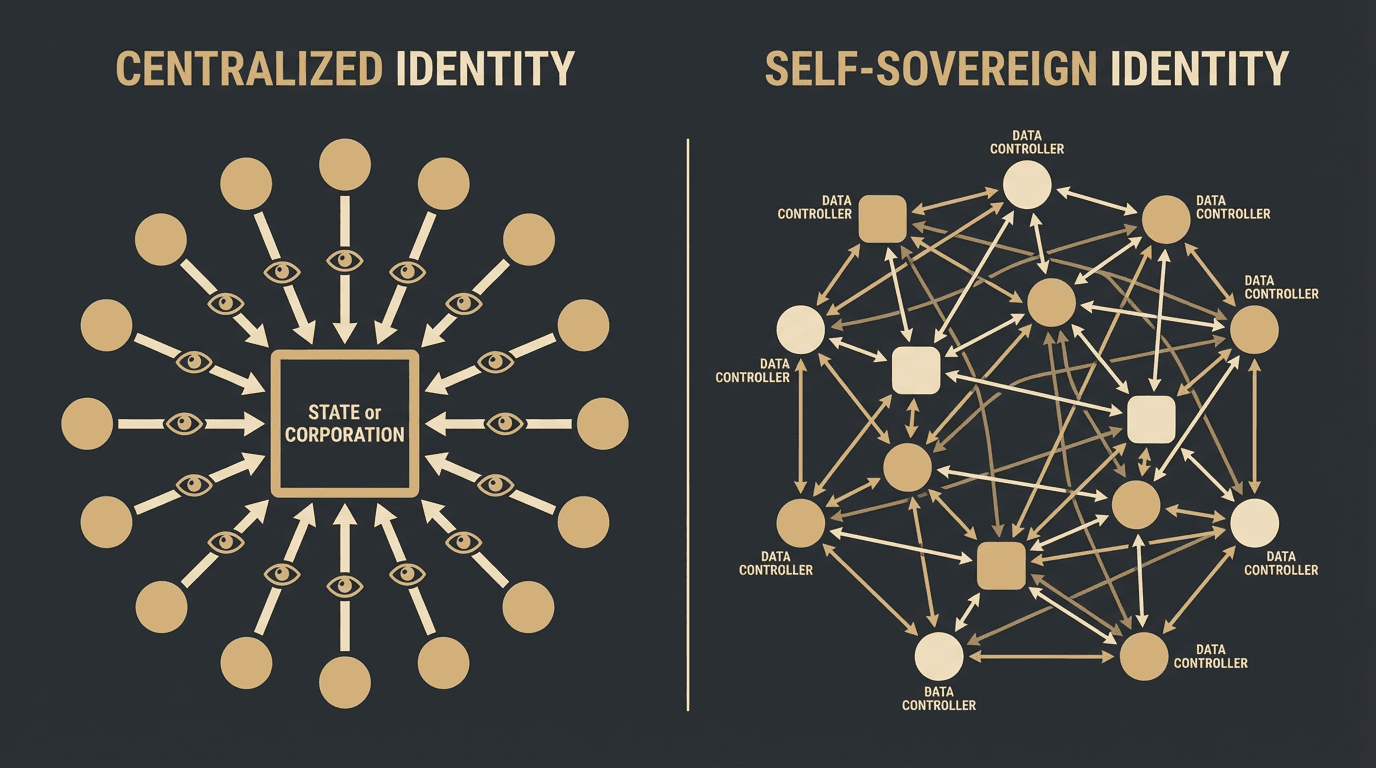
Links: zentralisiertes Modell, ein einzelner Betreiber kontrolliert alle Daten und kann erfasst oder gezwungen werden. Rechts: SSI-Modell, kein zentraler Betreiber, Verifikation ist kryptografisch, Nutzer kontrollieren ihre eigenen Daten.
Das Toleranzparadox, direkt adressiert
Karl Popper (1945) hat das Kernproblem beschrieben: Eine Gesellschaft, die Intoleranz toleriert, wird schließlich durch sie zerstört. Axiom 10draws the line. Beliefs are protected absolutely. You can say “this system should be destroyed” that is an opinion, protected. You can publish manifestos, organize politically, criticize every axiom publicly. All of this is protected. What is not protected is coordinated action designed to structurally sabotage the foundational axioms to physically or organizationally prevent the system from functioning.
Der Einwand folgt sofort: „Wer entscheidet, was als Sabotage gilt?" Das ist die richtige Frage. Und die Antwort lautet: keine Behörde, kein Komitee, keine Regierung. Die Unterscheidung ist in den Axiomen selbst definiert. Rede und Organisation sind geschützt; Handlungen, die die konstitutionelle Schicht direkt außer Kraft setzen, nicht. Jede Anwendung dieser Regel ist öffentlich protokolliert, transparent und rechtlich anfechtbar. Ja, sie wird missbraucht. Jedes Rechtskonzept wird missbraucht. Die Antwort darauf ist Transparenz und Anfechtbarkeit, nicht das Aufgeben der Unterscheidung.
Das Problem der Letzten, die gehen
Austritt hat staatliche Macht historisch begrenzt. Hirschman (1970) hat dies formalisiert: Wenn Menschen eine Institution verlassen können, diszipliniert diese Option sie. Die Austrittsdrohung setzt eine untere Schranke dafür, wie missbräuchlich Governance werden kann, bevor sie ihre Bevölkerung verliert. Wenn der Austritt verschwindet, verschwindet der Disziplinierungsmechanismus mit ihm. Dann bleibt nur die Stimme: Protest, Druck, organisierte Opposition. Wird auch das unterdrückt, lebt das System auf geborgter Zeit.
Die moderne Version dieses Problems ist technischer, nicht rechtlicher Natur. Wenn der Austritt gleichzeitig eine staatlich ausgestellte digitale Brieftasche, ein geofenced Fahrzeug und eine registrierte Identität erfordert, wurde die Austrittsoption eliminiert, ohne ein einziges Gesetz, das Ausreise explizit verbietet. Axiom 3 adressiert dies direkt: Konzentration der Kontrolle über Mobilitäts- und Wirtschaftsschichten ist auf derselben konstitutionellen Ebene verboten wie politisches Monopol.
Die Berliner Mauer wurde nicht gebaut, um Menschen fernzuhalten.
Austritt als System-KPI
Das Recht auf Austritt hat eine zweite Funktion jenseits des Individualschutzes: Es ist ein Indikator für die Governance-Gesundheit. Ein System, das Menschen nicht verlassen können, ist kein funktionierendes System. Es ist ein Gefängnis mit besserer Öffentlichkeitsarbeit. Ein System, das Menschen wählen nicht zu verlassen, weil es ihnen gut genug dient, hat einen Stresstest bestanden, den keine interne Prüfung replizieren kann.
Auswanderungsraten, Kapitalflucht und freiwilliger Weggang sind Diagnosesignale, keine politischen Peinlichkeiten. Wenn ein Governance-System den Austritt einschränkt, folgt diese Einschränkung fast immer derselben Logik: Das System hat das Vertrauen in seine eigene Legitimität verloren und setzt Kontrolle als Ersatz ein. Dieser Ersatz stellt Legitimität nie wieder her. Er verstärkt den Verlust nur.
Equiplurism behandelt die Attraktivität des Austritts als strukturelle Designvariable. Wenn Menschen in großer Zahl gehen wollen, stimmt etwas im Design nicht. Die richtige Antwort ist, das Design zu korrigieren. Jedes scheiternde System greift schließlich zur gleichen falschen Antwort: das Gehen schwerer zu machen.
Die einzige legitime Einschränkung der Bewegungsfreiheit
Eine und nur eine Grundlage rechtfertigt die Einschränkung des Aufenthaltsorts oder der Bewegungsfreiheit einer Person: Strafe für eine selbst verursachte Verletzung des geltenden Rechts, sofern dieses Recht innerhalb eines allgemein anerkannten moralischen Spektrums operiert und durch transparente, anfechtbare, rechtsstaatliche Verfahren angewendet wurde.
Inhaftierung wegen Meinungsäußerung ist unter keiner Rahmung tolerierbar. Nicht als nationale Sicherheit. Nicht als öffentliche Ordnung. Nicht als Hassrede, die unterhalb der Schwelle der Anstiftung bleibt. Eine Meinung kann per definitionem kein Verbrechen sein.
Unkenntnis des geltenden Rechts ist kein Rechtfertigungsgrund. Rechtssysteme haben dies immer so gehalten, aus strukturellen Gründen. Das Hinterfragen eines Gesetzes, der öffentliche Widerspruch dagegen, die Organisation dagegen oder die Forderung nach seiner Aufhebung nimmt jedoch eine kategorisch andere konstitutionelle Stellung ein als seine Verletzung. Das Verwischen dieser Unterscheidung ist der Mechanismus, mit dem jedes autoritäre System seine ersten politischen Strafverfolgungen rechtfertigt. Ist die Unterscheidung einmal aufgelöst, kehrt sie nicht ohne erhebliche Kosten zurück.
Zwei vorhersehbare Angriffe
Von rechts: „Das ist globalistische Überwachungsinfrastruktur."
Equiplurism ist explizit antizentralistisch. Regionale Autonomie ist strukturell in Axiom 5. verankert. Es gibt keine Weltregierung, kein zentrales Register, keine supranationale Behörde. Die Identitätsinfrastruktur ist konzeptionell dezentralisiert, technisch unmöglich ohne Axiomverletzung als Überwachungssystem zu betreiben.
Von links: „Verantwortungsgewichteter Einfluss ist Meritokratie mit besserem Branding."
Klassische Meritokratie belohnt Produktivität und Leistung, was strukturell die bereits Privilegierten bevorzugt. Verantwortungsgewichteter Einfluss belohnt Rechenschaftspflicht und Fachkompetenz, das ist etwas anderes. Eine Pflegekraft hat mehr Gewicht bei Gesundheitsentscheidungen als ein Vorstandsvorsitzender. Ein Bauarbeiter hat mehr Gewicht in der Infrastrukturpolitik als ein Berater. Die Gewichtung ist domänenspezifisch, begrenzt und wird regelmäßig per Mehrheitsbeschluss überarbeitet.
Der tiefere strukturelle Unterschied: Meritokratie hat keine Obergrenze für angehäufte Vorteile. Ein Abschluss, ein Netzwerk, eine Erfolgsbilanz kompoundieren sich unbegrenzt. Verantwortungsgewichteter Einfluss ist nicht erblich, nicht käuflich und erlischt, wenn die nachgewiesene Rechenschaftspflicht in einem Bereich endet. Die Kritik ist berechtigt, deshalb muss die Unterscheidung strukturell sein, nicht rhetorisch. Das Gewicht einer Pflegekraft in der Gesundheitspolitik ist keine Metapher. Es ist eine konstitutionelle Designanforderung.
Von Libertären: „Jede Identitätsinfrastruktur wird zu einem Kontrollmechanismus."
Dies ist der technisch ernsthafteste Einwand. Die Antwort ist architektonisch, nicht politisch: Self-Sovereign Identity bedeutet, dass es keinen zentralen Betreiber gibt, der gezwungen, vorgeladen oder beschlagnahmt werden kann. Man kontrolliert die eigenen Identitätsdaten. Der Staat kann sie nicht abfragen. Kein Unternehmen besitzt sie. Diese Garantie ist kryptografisch, nicht rhetorisch. Der Einwand trifft auf zentralisierte Identitätssysteme zu. Equiplurism schlägt keines vor.