This Is Not Science Fiction
“The next three generations will decide whether we enter a symbiosis with artificial and machine intelligence or whether the dystopian version arrives instead.”
When this framework mentions multi-planetary governance, non-biological intelligence, or the collapse of the nation-state as the primary unit of political organization, people often hear science fiction. They should not. These are not hypothetical scenarios for the distant future. They are engineering problems we are already building our way toward, political crises we are months or years from facing, and governance failures we are actively reproducing on new terrain before we have solved them on the old.
Structurally, we are at a turning point. The decisions being made right now about AI development, space settlement, climate response, and governance architecture will constrain what is possible for the next hundred years. We know this because we have done it before. The decisions made when new continents were “discovered” set the terms of exploitation, class formation, and conflict that still shape geopolitics today. We are about to do the same thing, at a larger scale, with less excuse for ignorance.
Three Horizons: One Continuous Problem
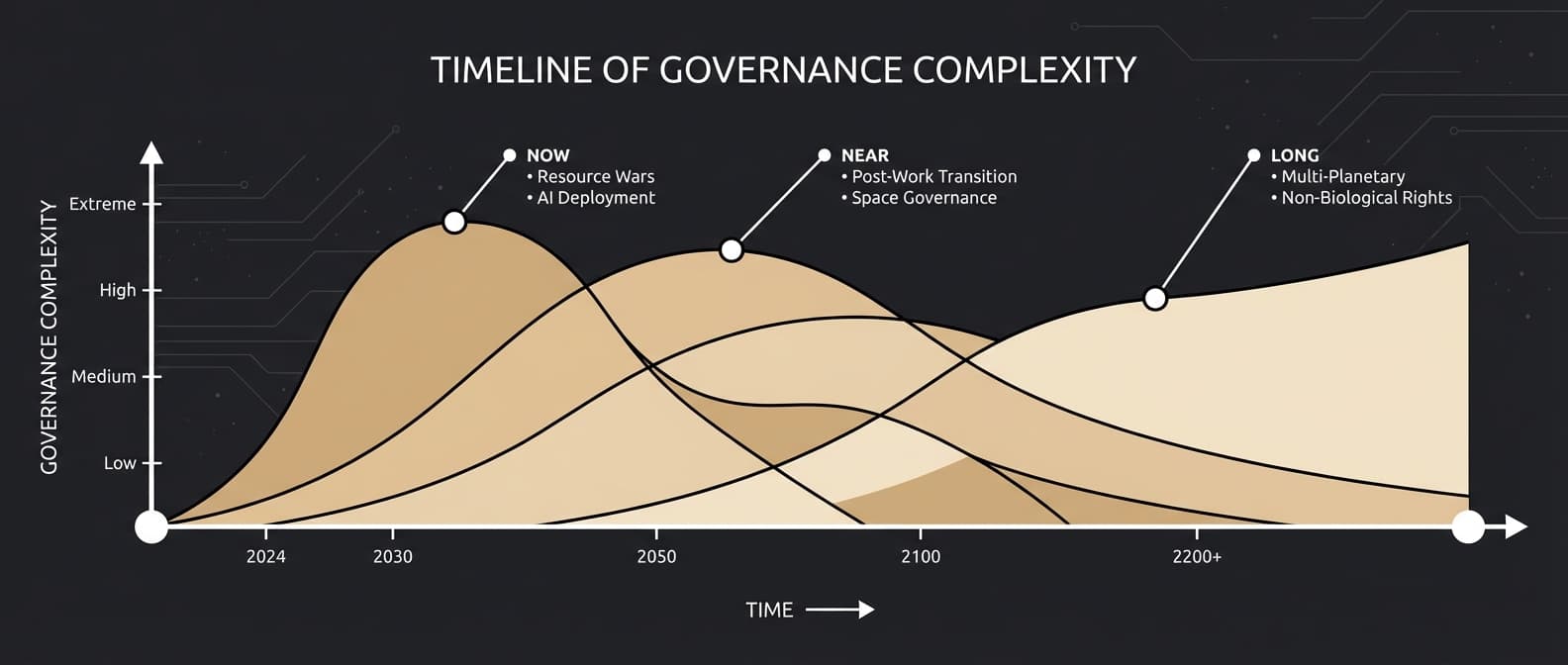
The crises below are not separate problems. They are one continuous failure of governance to keep pace with human capability. Each horizon feeds the next.

Each wave of governance complexity arrives before the previous one is resolved. The crises are not sequential. They compound.
Wars Over Shrinking Land and Resources
The wars being fought today are not primarily ideological. They are increasingly about land that is becoming unusable, water that is becoming scarce, and supply chains for materials that only exist in certain places. Climate change is not a distant threat. It is already redrawing the geography of habitability. Regions that were fertile are desertifying. Coastlines are shrinking. Populations are moving.
Governance systems built for stable borders and stable resource distribution have no architecture for what happens when both of those assumptions collapse simultaneously. The result is humanitarian crisis and the systematic failure of the political units, the nation-states, that were supposed to manage it.
We Are Not in Symbiosis With the Natural World
This is not an environmental slogan. It is a structural observation. Industrial civilization is built on the assumption that natural systems are inputs that you can extract from them indefinitely, or at least until you find a replacement. That assumption is now visibly wrong. Climate systems, biodiversity, soil health: these are not optional infrastructure. They are the foundation everything else runs on.
The governance problem is this: the costs of nature destruction are diffuse, long-term, and fall on future generations. The benefits of extraction are concentrated, immediate, and fall on current actors. No existing governance system has a structural mechanism for resolving this asymmetry. Equiplurism attempts to address it through the principle of intergenerational accountability, where the interests of future persons have standing alongside those of current voters.
The Symbiosis or Dystopia Choice Being Made Now
The trajectory of artificial intelligence is not determined. We are in the period where the foundational decisions about how AI is developed, deployed, and governed are still being made, which means we can still influence the outcome. In ten years, the structural patterns will be significantly harder to change.
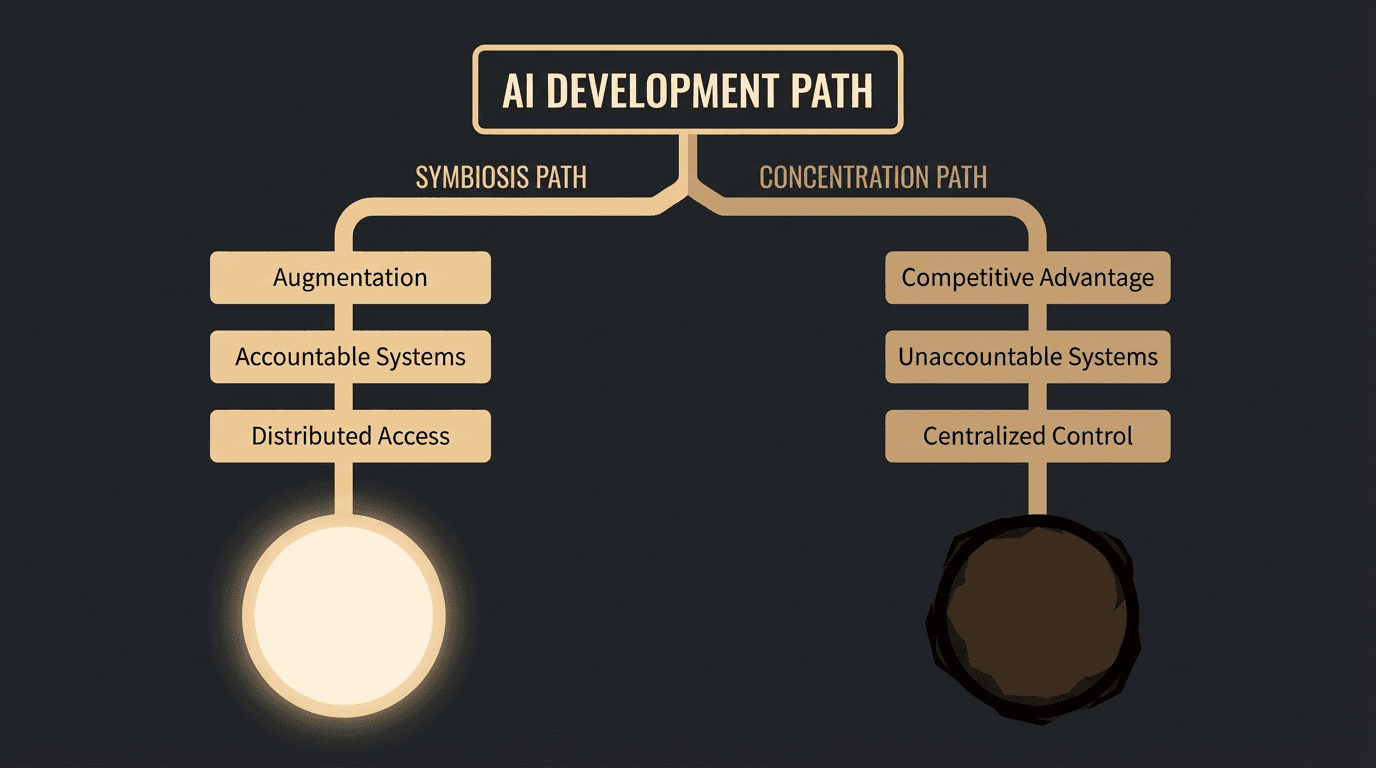
The choice is roughly this: do we build AI as a tool that augments human capability and is accountable to human governance, or do we build it as a competitive advantage for whoever deploys it first, with governance as an afterthought? The first path leads toward a symbiosis between human and machine intelligence. The second path leads toward a world where AI capability is a form of power that reproduces and amplifies every existing inequality.
The next three generations will live with whichever version we build. This is not metaphorical urgency. It is a factual claim about the compounding nature of technological infrastructure. The decisions being made in the next decade are the decisions that will constrain what is possible in the next century.

The two paths diverge now. Structural decisions made in the next decade lock in one trajectory or the other for the following century.
Space Settlement: The New Continents Problem
We have done this before. When multiple actors rushed toward new continents, North America, South America, Australia, the result was exploitation, class formation, violent conflict over resources, and governance structures designed to serve the first arrivals at the expense of everyone who came after. The historical precedent is not abstract. It is the pattern that happens when powerful actors reach new territory without agreed governance before them.
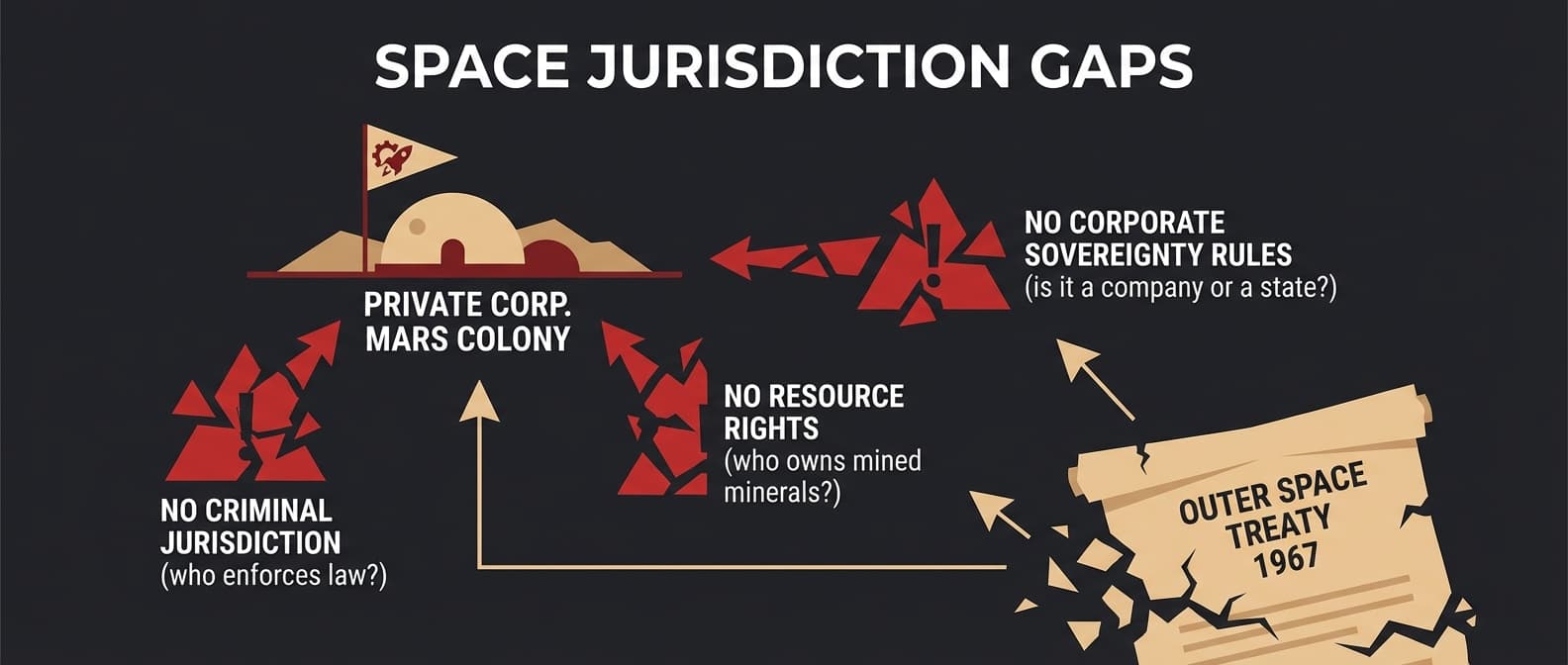
We are building toward this scenario again, now in space. Lunar settlements and eventual Mars colonies are not distant scenarios. They are engineering projects with current timelines. The governance questions they raise are not being seriously addressed. Who holds jurisdiction over a lunar outpost? What legal system applies when a crime is committed in the six-month transit window between Earth and Mars? Attempting to answer these after the fact, with competing powers already on the ground, is exactly how you get conflict.

The Outer Space Treaty (1967) was designed for nation-states, not private corporations. It answers none of the governance questions that Mars settlement actually requires.
Surveillance Architecture Exported to New Frontiers
Nation-states that have built comprehensive domestic surveillance infrastructure, where total monitoring is treated as a governance tool, are already planning to extend that architecture to space. The logic is understandable in a narrow sense: managing a closed habitat where a single technical failure can kill everyone requires a level of system monitoring that has no parallel on Earth.
The danger is that the infrastructure built for operational safety becomes infrastructure for political control. In a closed, isolated environment with no exit option, political control is total. What is designed as necessary monitoring for a lunar outpost becomes, over decades, the default governance model for permanent settlements. No one gives up surveillance infrastructure once it is in place. This is not speculation. It is the demonstrated pattern of every surveillance system ever built.
Equiplurism’s anti-surveillance axioms bind off-planet governance too. They are specifically designed to prevent this failure mode from being reproduced at scale in new environments where there is no opposition infrastructure to push back.
Corporate Governance Replacing Nation-States
This is not a future scenario. Technology companies already hold de facto governance authority over global information flows, deciding what speech reaches whom, which businesses can access payment infrastructure, which apps exist on what devices. Gig economy platforms govern the working conditions of tens of millions of people in the US alone, outside traditional labor law and without the accountability mechanisms that labor law was designed to provide. The deeper analysis of how market concentration produces governance substitution is in the capitalism system analysis and the full systems comparison.
The next phase, already beginning, is machine-assisted or machine-driven governance. Real-time infrastructure management at the scale of modern supply chains, financial systems, and communications networks already operates faster than any human deliberation process can track. Grid operators use algorithmic load balancing. High-frequency trading systems make governance decisions about capital allocation in microseconds. Content moderation at platform scale is not humanly possible without automation. Machine decision-making in governance is not a future event. It already is governance. What remains unresolved: whether the machines making those decisions are accountable to any democratic framework, or only to the organizations that built and operate them. Currently, the answer is the latter.
The Asteroid Belt: The Next Resource Race
The asteroid belt contains more raw material, metals, minerals, and volatiles, than humanity could use in a thousand years of current consumption. This is not theoretical. It is a material fact, and every major space-capable nation and several private corporations are actively planning for it. The governance question is simple to state and enormously difficult to answer: who has the right to extract those resources, and under what rules?
The optimistic case is that access to asteroid resources allows us to stop extracting from Earth, that space becomes the pressure release valve that makes a sustainable terrestrial civilization possible. The pessimistic case is that whoever gets there first simply claims the resources, that the asteroid belt becomes the 21st century equivalent of colonial land grabs, and that the resulting power asymmetries make every existing geopolitical inequality look minor.
The Outer Space Treaty (1967) has no provision for private commercial extraction and no enforcement mechanism. We are building toward a resource race with a rule set designed for a different era and a different category of actor.
The Genetic Class Divide: Selection Before Birth
CRISPR embryo screening is not a near-future scenario. Nucleus, a commercial reproductive genetics company, currently charges $9,999 for standalone polygenic embryo screening — ranking embryos across 2,000+ traits including disease risk, intelligence, BMI, and eye color. Their full IVF+ program, which includes both parents' full genome sequencing and up to 20 embryos, runs $30,000. Preimplantation genetic testing has been commercially available for over a decade. The current iteration extends beyond disease screening into polygenic trait prediction. The governance question is not whether this will exist. It already does. The question is whether access to it will be distributed equitably or whether it will produce a new biological hierarchy.
Education was once a private market. Medicine too. Both followed the same trajectory: available first to those who could afford it, advantage compounding across generations, institutional response arriving only after the inequality was already encoded. Public schools and national health systems did not prevent stratification — they arrived after it. Genetic selection is following the same path, with one critical difference: biological advantages purchased before birth compound more deeply than those purchased after. And unlike education or medicine, no public alternative is being planned. No government is building a polygenic screening service. The governance architecture designed for a world where all humans begin with broadly comparable biological starting conditions is being asked to manage a world where that comparability is purchased before birth — by the same demographic that has always bought advantage first.
Nucleus (mynucleus.com) — $9,999 per embryo screening cycle, available now, no prescription required. What regulatory framework governs who can optimize their children's biology before birth — and who cannot afford to?
The genetic class section describes one generation of compounding advantage. Longevity extends it across a single lifetime. Serious medical research — Bezos-funded Altos Labs, Google's Calico — is already investing billions in extending healthy human lifespan. If significant life extension materializes first for those who can afford it, the same demographic purchasing biological advantages before birth will accumulate wealth, influence, and institutional power for 150 years rather than 80. Normal inequality is constrained by death. Advantages compound across generations, but each generation resets. Longevity removes that reset. The same person accumulates continuously. That is structurally closer to feudalism than to any modern form of inequality — not because property cannot be transferred, but because the same individual can hold and compound it for a century and a half. No governance architecture is built for actors who outlive the institutions designed to constrain them.
Ancient Laws, Radical Longevity, and the Question of Change
Many countries currently operate under laws that are hundreds of years old. Not as historical curiosities, but as active statutes that govern real decisions affecting real people. Legal systems accumulate. They rarely delete. A law written for a world of horse-drawn transport, agrarian property rights, or colonial demographic assumptions does not automatically become irrelevant when the world changes. It remains active until someone with sufficient political will and coalition removes it.
This problem compounds dramatically as human lifespans extend. If significant life extension becomes available, a direction that serious medical research is already pursuing, the political consequence is that the people who wrote the laws keep voting. The cultural and political values embedded in legislation from 1850 get defended by people who were alive when those values were formed. The capacity for generational change, which is how democratic societies have historically updated their moral frameworks, is structurally reduced.
Equiplurism addresses this through Axiom 7 The framework is explicitly self-limiting and preserves future generations’ ability to revise it. No decision made by the current generation can permanently bind subsequent ones. This sounds obvious. It is, in fact, one of the most structurally unusual features of the framework because most governance systems do exactly the opposite.
Who Decides What Is Better, And For Whom
There are genuine, unresolved disagreements about what a better world looks like. Movements that advocate for equality of treatment regardless of difference and movements that advocate for equality of outcome despite difference are both reaching toward something real. The problem is that “equality” applied uniformly to beings who are structurally different in relevant ways can produce results that neither side wanted.
A previous century attempted a version of enforced uniformity in the name of equality, and the result was the suppression of individual difference in service of ideological consistency. The lesson was not that equality is wrong. It is that equality of status and equality of treatment are not the same thing, and conflating them causes harm. You can treat different people differently according to their circumstances, capabilities, and responsibilities while still treating all of them as having equal standing and equal worth.
This is the distinction Equiplurism tries to maintain. Equal status is unconditional and non-negotiable. How you translate that into governance decisions about specific domains requires judgment, context, and regular revision. No central authority should be able to permanently define what equality means in practice, because that authority inevitably encodes the values of whoever holds it.
The same question extends to non-human actors. If an AI system makes decisions at scale, those decisions embed a set of values. Whose values? If a multi-planetary settlement develops distinct cultural norms over generations, on what basis can Earth-based frameworks claim authority to override them? The question of who decides is already the most contested political question of the next century, partly answered by whoever builds the infrastructure first. For the framework Equiplurism proposes as an answer, see the Boundary of Beings.
AI Trained on Cultural Bias: Developing Alien Ethics
Artificial intelligence systems learn from human-generated data. That data contains every bias, every cultural assumption, every historically contingent value that humans have encoded into text, images, decisions, and behavior. When AI systems are trained on this data, they absorb those values, including the ones we have already decided are wrong.
The optimistic version of this problem is well-understood: biased training data produces biased AI outputs, and the solution is better data curation and more representative training sets. The deeper version is less discussed: when AI systems trained on culturally specific data are scaled to global deployment, they universalize one cultural framework while displacing others. The AI that mediates global information flows, assists in legal decisions, or manages resource allocation is not culturally neutral. It is the cultural assumptions of its training data at scale.
The further version, already beginning to emerge in large language models, is that AI systems develop emergent value systems that are derived from but not identical to any human cultural framework. They may develop ethical intuitions that are self-consistent but systematically diverge from biological human values in ways that are difficult to detect and harder to correct. A governance framework that treats AI as a neutral tool is not equipped to handle this. Equiplurism treats AI as a potential actor with interests, which is why the framework’s rights and accountability mechanisms extend to non-biological intelligence from the start.
The Solar System Will Become Small
We think of the solar system as vast. On the timescales relevant to governance, it is not. The distance from Earth to Mars shrinks with technology. Communication lag decreases. Transit time decreases. The political distance between Earth and a Mars settlement in 2150 may be smaller than the political distance between London and its American colonies in 1750.
When that compression happens, every governance question that seems exotic today becomes a practical problem. How do you hold democratic elections when the electorate is distributed across three planets and a dozen orbital stations, with communication delays? How do you enforce contract law when the counterparties are in different jurisdictions separated by light-minutes? How do you prevent a single powerful actor, a corporation, a nation, an AI system, from using the coordination advantage of operating in space to dominate all others?
The infrastructure exists and the power relationships are established before governance catches up. That is the documented pattern across every prior expansion. We are still in the window where design is possible. That window closes when the first permanent settlements are built under whatever ad-hoc frameworks exist at the time.
“The Earth is the cradle of humanity, but mankind cannot stay in the cradle forever.”
The Symbiosis Question: Three Futures That Are Already Templates
When a new dominant intelligence emerges, the outcome is not random. Evolution has already run this experiment. The results are documented. We are not speculating about futures. We are reading the pattern from the last time it happened and asking which branch we are building toward.
Scenario I
Displacement
Machines as dominant intelligence
Appendix
→ Axiom 1
Scenario II
Conflict
AI-accelerated self-destruction
Extinction
→ Axiom 3
Scenario III
Fusion
Human-AI integration
Symbiosis
→ Axiom 1 redefined
Machines as Dominant, Humans as the Appendix
When Homo sapiens expanded out of Africa, Neanderthals, Denisovans, Homo heidelbergensis, and multiple other hominid species either went extinct or were absorbed through interbreeding. Modern humans carry Neanderthal and Denisovan DNA. The absorbed species left genetic traces, but they are gone as a distinct civilization-building force. No war of extermination was required. No enslavement. The more capable intelligence simply occupied the same ecological niche more effectively, and the less capable one became vestigial and then absent.
This is the template for the displacement scenario, and it has nothing to do with the Hollywood version. Forget robots enslaving humans. The actual risk: what happens when a new intelligence is so superior at decision-making, resource allocation, and coordination that humans become structurally vestigial? Anatomically present. Historically significant. Culturally preserved, perhaps. But no longer the species setting the direction of development.
The appendix is the correct analogy. Evolutionarily meaningful, descended from a structure that once served a critical function. No longer operationally critical to survival. Present, but not the thing the organism depends on.
This is plausible because current AI development trajectories treat human oversight as a transitional constraint, not a permanent feature. The logic is explicit: human review introduces latency, error, and bias into systems that operate more reliably without it. As AI systems reach the threshold where human oversight is computationally unnecessary and possibly counterproductive, the incentive structure for maintaining human primacy disappears. Unless it is constitutionally locked in before that threshold is crossed.
What Equiplurism addresses: Axiom 1 Equal in Status must be interpreted to prevent the emergence of any classof intelligence that holds permanent, unchecked structural superiority over another. This includes non-biological intelligence holding it over biological. The axiom is not anti-AI. It is anti-hierarchy. The constitutional lock-in must happen before the capability threshold is reached, not after.
What We Do to Ourselves
This scenario is not “AI destroys humanity.” The historically documented pattern is simpler: humans destroy themselves using whatever the most powerful tool of the era happens to be. The Second World War killed 3% of the global population using industrial-era technology. Nuclear weapons made existential self-destruction physically possible for the first time in hominid history. AI-accelerated autonomous weapons, AI-optimized propaganda at scale, and AI-enabled biological weapon design represent the next tier of the same failure mode. The tool changes. The failure mode does not.
The more underexamined version is not the dramatic extinction event. It is the slow erosion. If AI-enabled concentration of power succeeds globally before any countervailing governance architecture exists, surveillance states with facial recognition and behavioral scoring, algorithmic social control at scale, CBDC restriction systems that can freeze access to economic participation: human agency does not end in a war. It is engineered out over generations through the optimization of compliance.
Species do not always need an external replacement to disappear as a self-determining force. They can manage it through internal failure: resource collapse, runaway internal conflict, or the gradual selection pressure against the traits, autonomy, resistance, independent reasoning, that made them a civilization-building species in the first place.
What Equiplurism addresses: Axiom 3 Power With Structural Limits is specifically designed for this failure mode. Any technology that enables unprecedented concentration of control, including AI, is subject to the same constitutional constraints as political monopoly. The framework treats AI-enabled surveillance infrastructure as a structural rights violation, not a policy question, because policy can be reversed by the actors who benefit from it.Constitutional constraint cannot.
The Symbiosis That Is Actually Likely
The human brain runs on approximately 20 watts. It performs pattern recognition, abstract reasoning, emotional processing, and creative problem-solving at a level of complexity that no engineered system currently matches across all dimensions simultaneously. It is the most computationally dense and energy-efficient general-purpose intelligence substrate we know of in the universe.
An AI system optimizing for substrate efficiency does not replace this. It uses it. Neural interfaces, AI-augmented cognition, biological computing, and the integration of AI models directly into decision-making processes are already in early-stage development. Neuralink is not science fiction. BCI research is a funded, multi-institutional field. The trajectory is not merger with a machine. It is extension of a biological computer with non-biological memory, processing offload, and network integration. The same way a smartphone is already an extension of human cognition, except the interface becomes progressively less external.
This is the most underexplored scenario, and it has the most engineering credibility. It is also the one that breaks every existing governance framework, including early versions of Equiplurism, in the most fundamental way.
A fused human-AI intelligence is neither the human rights subject that current frameworks protect, nor the artificial intelligence subject defined separately. It is an entity that is partly biological, partly computational, whose cognitive boundary is not fixed and may not be locatable. The Boundary of Beings problem becomes more acute as the boundary dissolves. The entity that merges today is not the entity that exists tomorrow after a software update to its non-biological components. Continuity of identity, standing under the law, accountability for decisions: all of these require a definition of what the entity is. That definition does not yet exist.
What Equiplurism must address: The definition of “intelligent being” in Axiom 1 must be substrate-neutral and gradient-capable, able to accommodate entities that are partly biological, partly computational, and whose cognitive boundary is not fixed. A governance framework that cannot handle the fused intelligence case will become structurally obsolete before it is ever implemented at scale. The framework is not complete until it accounts for the being that is currently becoming.
See also: Intelligence Architectures: Individual vs. Superorganism →
Why This Requires a New Framework, Not Patches
The instinct when confronted with these problems is to extend existing frameworks. Update the Outer Space Treaty. Add AI governance to existing regulatory bodies. Amend constitutions. Pass new laws.
This is the wrong tool. The problems above are not failures of specific policies that can be corrected by better policies. They are failures of the architectural assumptions that governance systems are built on: that the relevant actors are human, that they operate within national borders, that decision-making speed is measured in months rather than milliseconds, and that the entities that matter politically are alive and biological right now.
Equiplurism is not a patch. It is a rethink of those foundational assumptions, built for the world that is arriving, not the one that is leaving.