Geçiş
“Devrim değil. Katmanlama.”
Equiplurizm’in geçiş modeli gelecek hakkında bir teori değil. Bugüne dair bir gözlemdir. Yönetişim en azından 1990’lardan beri değişim hızına yetişemiyor: ticaret anlaşmaları işçi korumalarından hızlı ilerledi, finansal sistemler küreselleşirken düzenleyici çerçeveler ulusal kaldı. Son on yılın yönetişim başarısızlıkları ortak bir yapıyı paylaşır: kurumsal yanıt kapasitesini aşan değişim. Equiplurizm’in kabulü için koşulları yaratmasına gerek yok. Bu koşullar zaten burada.
Yönetişim çerçevelerine en yaygın itiraz geçiş sorunudur: buradan oraya nasıl gidilir? Var olan hiçbir güç yapısı gönüllü olarak etkisinden vazgeçmez. Hiçbir sistem daha iyisine yer açmak için kendini sökmez. Bu itiraz doğrudur; bu yüzden Equiplurizm bir ikame olarak tasarlanmadı. Mevcut kurumların üzerine konmak, modüller halinde benimsenmek ve kanıtlar biriktikçe genişlemek üzere tasarlandı. Politik devrime ihtiyacı yok. Mevcut sistemlerin başarısız olmasına ihtiyacı var ki oluyorlar ve o anda hazır, inandırıcı bir alternatife.
Geçiş modeli mevcut sistemlerin kötü olduğunu varsaymaz. Yavaş olduklarını varsayar. İyi işleyen bir demokrasi, iyi düzenlenmiş bir pazar, yetkin bir devlet bürokrasisi bunların hepsi kötü uygulanmış bir Equiplurizm’den iyidir. Çerçeve var olana ahlaki bir yargı değildir. Yapısal bir gözlemdir: değişim hızı, şu anda işleyen her yönetişim modelinin yanıt kapasitesini aştı.
En iyi tarihsel benzetme politik devrim değildir. İnternetin benimsenmesidir. Hiçbir devlet interneti yönetişim seçimi olarak inşa etmeye karar vermedi. Parça parça kuruldu, yararlı bulan kurumlarca benimsendi ve çoğu hükümet ne olduğunu anlamadan altyapı oldu. AB de tek bir politik kararla oluşmadı: ticaret anlaşmaları, sonra işbirliği antlaşmaları, sonra para birliği, sonra politik koordinasyon katmanları üst üste bindi. Her katman bir sonrakini kolaylaştırdı. Model budur.
Substratlar zaten mevcut
AB'nin GDPR'ı ve Dijital Hizmetler Yasası, üye devletleri etkin veri denetleyicilerine dönüştürdü çoğulcu yönetişim teorisiyle değil, ABD platform egemenliğine yapısal bir direniş olarak. Çin'in Büyük Güvenlik Duvarı ve Rusya'nın Runet'i, paylaşılan internet protokol katmanı içinde çalışan bağımsız teknik altyapılardır. Uluslararası tedarik zincirleri, Çin devlet kapitalizmini, Alman ordoliberalizmini ve Amerikan liberal piyasalarını aynı üretim ağı içinde birleştiriyor birbiriyle bağdaşmayan üç sistem, sınırda işlevsel birlikte çalışabilirlik sağlıyor. Ve yüz milyonlarca iki dilli birey her gün iki tam dilbilgisel ve normatif sistemi paralel olarak işletiyor, aralarında bağlamsal olarak geçiş yapıyor ve hiçbiri çökmüyor.
Bunların hiçbiri Equiplurizm değil. Hiçbiri çoğulcu yönetişim olarak tasarlanmadı. İddia daha dar: bu olgular önkoşulların zaten karşılandığını kanıtlıyor. Paralel kural sistemleri, yakınsama gerektirmeksizin bir arada var olabilir, iç tutarlılığını koruyabilir ve tanımlı sınırlarda birlikte işleyebilir. Henüz mevcut olmayan şey, bunu kasıtlı kılan biçimsel yönetişim katmanıdır tesadüfi birlikte varoluşu tasarlanmış çoğulculuğa dönüştürecek birlikte çalışabilirlik protokolleri, haklar tabanı, hesap verebilirlik mekanizmaları.
Küreselleşme eleştirisi tam ters yönde ilerliyor. Küreselleşme bir yakınsama vektörüdür: DTÖ standartları, dolar cinsinden ticaret, fikri mülkiyet hukuku harmonizasyonu asimetrik güç altında homojenleşme. Yukarıda sayılan olgular, yakınsama baskısı altında ayrışmanın sürdüğünün kanıtıdır. GDPR, platform çağının homojenleşmesine karşı açık bir direniş olarak ortaya çıktı. Runet bunun yapısal bir reddidir. Bu olguların yarattığı substrat küreselleşmiş bir dünya değildir. Arayüzde operasyonel birlikte çalışabilirliği korumayı zaten öğrenmiş parçalanmış bir dünyadır. Equiplurizm, parçalanmanın tesadüfen inşa ettiğini resmîleştiriyor.
“You never change things by fighting the existing reality. To change something, build a new model that makes the existing model obsolete.”
Dört Aşama
Aşama 0
Şimdi
Fikirleri sabitle
Equiplurizm’i yapay zekâ yönetişimi tartışmalarına sokun. BM YZ Danışma Kurulu, AB Yapay Zekâ Yasası sonrası tartışmalar, Rawls, Habermas ve Post-İnsan Hakları’na karşı açık durumlar içeren akademik makaleler. Güç iddiası yok yalnızca mevcut kurumlara fikir ekimi.
Aşama 1
Pilot
Bir şehir. Bir deney.
Tek bir şehir. Sınırlı karar alanı: kentsel planlama veya yerel bütçe. Ölçülebilir bağlamda ağırlıklı müzakere. Dijital pilot olarak Kimlik Sicili. Başarı ölçütleri pilot başlamadan tanımlanır. Yapı kodları böyle yayıldı: bir şehir yangın güvenliği standardını benimsedi, sonuçları yayınladı, komşu şehirler kanıtlar kamuya açık ve benimsememenin maliyeti görünür olunca izledi.
Aşama 2
Benimseme
Modüller, sistemler değil
Tüm çerçeve değil ayrı modüller. Diğer bölgeler Aşama 1’de ölçülebilir sonuç vereni benimser. Her benimsenen modül belgelenir; böylece benimseme yukarıdan koordinasyon olmadan ölçeklenir. İnternet yönetişimi de böyle çalıştı: merkezi bir otorite interneti inşa etmeye karar vermedi. TCP/IP, bağımsız kurumların yararlı bulup benimsemesi ve benimsememeyi pahalılaştıran ağ etkileri yaratmasıyla altyapı oldu. Kanıt ikna yerine geçer.
Aşama 3
Sabitleme
Kurumsal entegrasyon
AB düzeyi, BM düzeyi. Mevcut kurumların yerine değil yapısal yükseltme olarak. Amaç demokrasiyi değiştirmek değil; tasarlanmadığı koşullarda işlemesini sağlamak.
The Physical Expansion Timeline Governance Doesn't Get a Delay
The governance of space is not a future problem. Artemis Base Camp (NASA/ESA/JAXA/CSA) is scheduled for 2030s lunar operations. SpaceX has announced Mars landing targets for the 2030s. The Outer Space Treaty of 1967 the foundational international legal framework governing space, written before humans landed on the Moon — prohibits national sovereignty claims on celestial bodies but says nothing about corporate sovereignty, nothing about resource rights on asteroids, nothing about criminal jurisdiction in a permanent settlement, and nothing about what happens when a private company is the de facto government of a Mars colony.
The asteroid belt contains an estimated $700 quintillion in mineral wealth a figure derived by applying current Earth commodity prices to estimated ore deposits, not a real market value. No extraction market exists. But at current rates of technological acceleration propulsion, robotics, materials science orbital extraction becomes an engineering problem within decades. Add active life-extension research compressing the psychological distance between now and 2150, and the governance vacuum stops being abstract. Institutions built today become the constitutional substrate for decisions that people alive today may personally face. Multiple companies (AstroForge, TransAstra, Karman+) are already developing extraction technology. Who sets the rules? Who collects the taxes? Who resolves disputes? Under current international law: nobody.
The lesson from Earth: every time humans settled new territory without pre-existing governance architecture, the result was extraction, conflict, and the creation of power asymmetries that lasted centuries. The Americas. Africa. The ocean commons before UNCLOS. We know the pattern. We are about to reproduce it at planetary scale.
2025
Infrastructure Phase
2030
Settlement Phase
2040
Extraction Phase
2050+
Jurisdictional Crisis
Phase I
2025–2030
The Infrastructure Phase
-
Artemis lunar Gateway station construction (NASA/ESA). First sustained human presence on the Moon Artemis Base Camp target: 2030. SpaceX Starship lunar cargo missions begin.
-
Luxembourg Space Resources Law already passed (2017) the first national law permitting private asteroid resource extraction. US Space Act (2015) followed. The legal fragmentation has already started.
-
First corporate governance question: who adjudicates a dispute between two private companies operating on the Moon? The Outer Space Treaty says states are responsible for their nationals but what if the company is registered in multiple jurisdictions, or none?
Phase II
2030–2040
The Settlement Phase
-
First Mars landing (SpaceX target range). Permanent lunar settlement: first 100 people. First Mars base: first 12–50 people.
-
The communications delay problem: Mars is 3–22 light-minutes from Earth depending on orbital position. Earth cannot govern Mars in real time. A Martian colony must have local governance authority by physics, regardless of political intention.
-
Elon Musk has already stated that SpaceX intends to draft a “Martian constitution” a private company writing the constitutional law of a new planet. This is not speculation. It is the declared plan.
-
The company-as-state problem: if SpaceX delivers 1,000 people to Mars and is the sole life support provider, it holds more structural power than any democratic government has ever held over its citizens. You cannot leave. You cannot survive without them. Standard labor and civil rights law cannot apply across a 20-minute communications delay with enforcement on another planet.
Phase III
2040–2060
The Resource Extraction Phase
-
Asteroid belt mining operations begin (earliest realistic estimate: 2040s). The belt contains: iron-nickel asteroids (16 Psyche alone estimated at $10 quintillion), water ice (rocket fuel), platinum group metals, rare earth elements.
-
Scale: a single mid-size metallic asteroid (1 km diameter) contains more iron than all of Earth's annual iron production.
-
Current legal vacuum: under the Outer Space Treaty, no nation owns asteroids. Under US/Luxembourg law, private companies can own extracted resources. Under no law does anyone govern the extraction process, environmental impact, or equitable distribution of value.
-
Who taxes the asteroid belt? Who enforces safety standards? Who arbitrates when two mining ships claim the same asteroid?
Phase IV
2050+
The Jurisdictional Crisis
-
Multiple Mars settlements from multiple national and corporate actors. Moon settlements under competing authority claims.
-
First generation of humans born off Earth they have never been to Earth, have no natural tie to any Earth jurisdiction. What rights do they hold? Under what legal system?
-
The question that ends the Outer Space Treaty framework: when a Martian-born human commits a crime, who has jurisdiction? When a corporation headquartered on Mars (for tax purposes) makes decisions affecting Earth who regulates them?
What Equiplurism Proposes for Space
-
Jurisdiction by presence, not nationality
Equiplurism applies to any persistent settlement of intelligent beings regardless of national origin. A Mars colony of 500 people from 30 nations operates under Equiplurism, not a patchwork of Earth national laws.
-
Corporate governance prohibition
No entity that controls life support, transportation, or communication infrastructure may simultaneously hold political authority. The company builds the habitat. It does not write the constitution.
-
Resource sovereignty by contribution
Asteroid belt resources are governed by a multi-stakeholder body. Extraction rights are earned through contribution to shared infrastructure communication relays, emergency rescue capacity, debris mitigation. Not auctioned to the highest bidder.
-
The communications delay principle
Any settlement more than 10 light-minutes from the nearest Earth governance node has autonomous local governance authority. This is not a political choice it is a physics constraint. Equiplurism builds this in explicitly rather than pretending Earth can govern Mars in real time.
-
The birthright clause
Any being born off Earth holds full rights under the framework without reference to their parents' nationality, corporate employer, or the flag of the mission that transported their parents.
NOW
2025
Institutional Adoption
NEAR
2035–2050
Structural Integration
LONG
2050+
Constitutional Entrenchment
The Strongest Entry Point: AI Governance
Of all the domains where Equiplurism could be introduced first, AI governance is the strongest entry point. The reasons are structural:
-
The debate is already international no single country has home advantage.
-
Equiplurism's Axiom 1 (intelligence not bound to biology) is directly relevant to the core question that AI governance bodies are struggling to answer.
-
The UN AI Advisory Body, the EU AI Act follow-on discussions, and the OECD AI Policy Observatory are all actively looking for frameworks. There is no dominant alternative that addresses both present governance gaps and future non-biological actors.
-
A paper positioning Equiplurism formally against existing frameworks enters a debate that has not been settled. That is a contribution, not just a position.
Pre-AGI Governance: What Applies Right Now
Equiplurism is not a framework for a hypothetical future. Before any threshold is crossed, before any system meets the rights-bearing criteria, there are concrete positions on how current AI systems should be governed. The core position: humans stay at the top of the accountability chain. AI as tool, not ruler. But specific not vague.
- 01.
No liability outsourcing
The institution or person that deploys an AI system is fully accountable for its outputs. “The model decided” is not a legal or ethical defense. Applies to: credit scoring, hiring, criminal risk assessment, medical diagnosis, content moderation. This is structurally equivalent to how we treat any delegated decision the principal retains accountability for the agent's actions.
- 02.
Auditable decision trails, not explainable models
We cannot fully explain how a 70B-parameter model produces a specific output. We can document: who deployed it, what data it was trained on, what human accountability structure governs its use, what override mechanisms exist. Governance requires the second, not the first. Connects to Axiom 8: no behavioral data without consent; all governance AI must have documented human accountability.
- 03.
Hard domain restrictions
No autonomous AI decisions on rights-affecting matters without genuine human review (not rubber-stamping): criminal sentencing, asylum applications, child custody determinations, medical diagnosis leading to treatment. The EU AI Act Article 22 establishes the right to human review Equiplurism makes it a constitutional floor, not a policy option.
- 04.
The capability-governance gap as the core crisis
AI capabilities advance in 6-month cycles (GPT-3 → GPT-4 → GPT-4o → o1, all within 3 years). Governance advances in 5-year cycles. This gap is not accidental it is the result of deployment decisions made by private actors with no accountability structure. The pre-authorized response protocol model (defined governance responses to defined capability thresholds, approved in advance) is the structural answer. Like nuclear test ban treaties: you don't negotiate after the test. You pre-authorize the response.
AI capability vs. governance response
AI capability curveExponential growthGovernance frameworksLinear responseGAP: every year the gap widens faster than any existing governance framework can close it.
- 05.
Why humans stay at the top the accountability argument
Not because humans are always right. Because accountability requires a being that can bear consequences. Current AI systems have no stake in the outcome, no liability, no experience of the effects of their decisions. Until a system meets all five rights-bearing criteria, it cannot bear accountability. And without accountability, it cannot hold decision authority. This is not anthropocentrism it is structural logic. When AI systems DO meet the criteria, the framework is designed to extend accountability to them. Until then: humans in the loop, always.
For the full assessment of where current AI systems stand against the rights-bearing criteria, see /beings → Current AI Assessment.
Minimum Viable Equiplurism
The framework does not need to be implemented in full to be useful. The smallest implementable unit is a single decision domain in a single city: a neighborhood council that adopts weighted deliberation, transparent decision records, and a structured challenge process. The axioms do not all need to be active. Modules can be adopted one at a time.
What matters is that the experiment is documented with pre-defined success criteria. Not anecdote: data. Not “it felt better” measurable outcomes that other regions can evaluate before deciding to adopt the same module. Proof replaces persuasion.
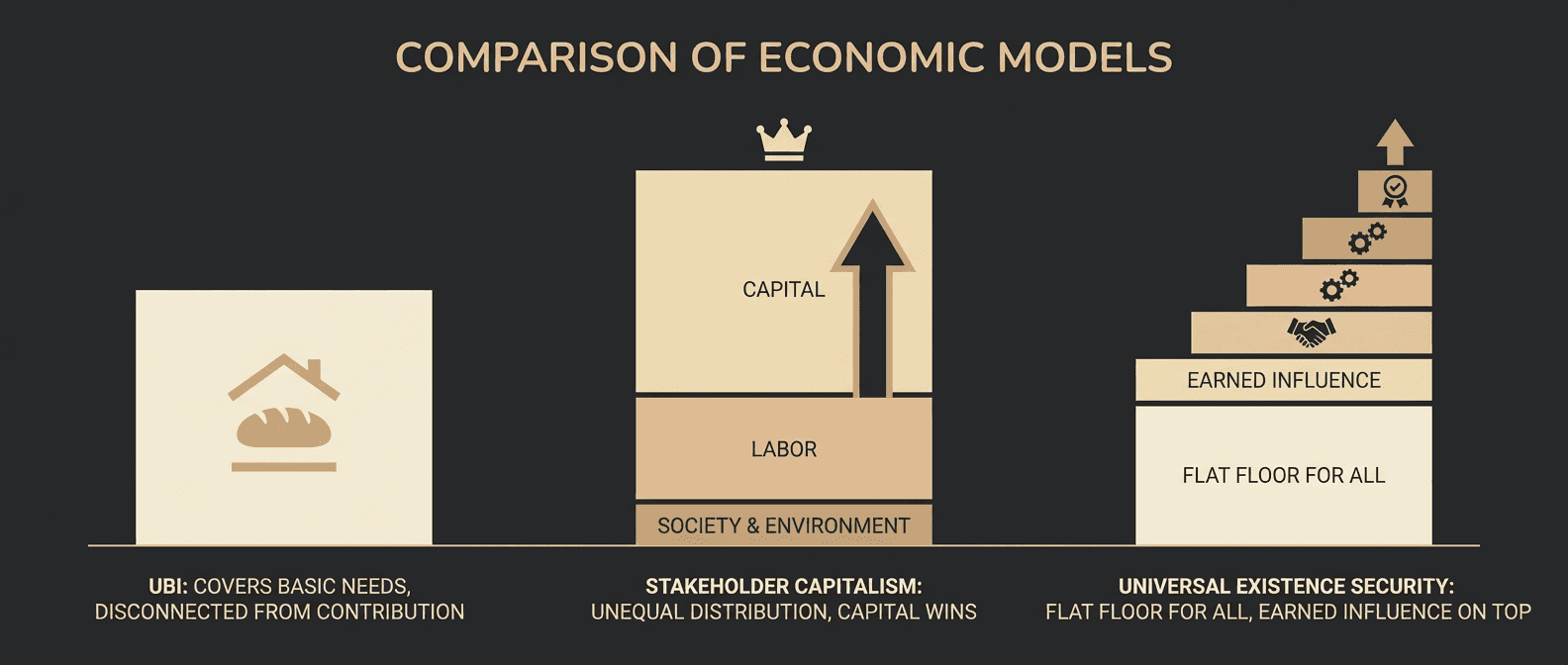
Three economic architectures compared current extractive capitalism, traditional welfare redistribution, and Equiplurism's responsibility-linked participation model.
This transition model is a hypothesis, not a promise. The phases above are how voluntary adoption could proceed if the framework finds traction. The model is falsifiable at every stage which is precisely what makes it worth publishing.
The Concrete Implementation Path
The hardest version of the transition objection is not philosophical. It is operational: a framework without an implementation pathway is a position paper. What is the concrete sequence of actions? Who does what, in what order, starting when?
The answer is four phases, each independently valuable, each a prerequisite for the next. None of them requires a political revolution. All of them are already technically possible. The model is not top-down political capture it is bottom-up adoption through proof. The precedent is participatory budgeting: one city experiment in 1989, now active in over 7,000 cities worldwide, never required a revolution, spread entirely through documented evidence.
The Reference Already Done
now-
This website is the reference architecture. Public, versioned, citable.
-
Every axiom, principle, and institution is specific enough to implement or challenge.
-
The proposal system creates the first feedback loop: public critique → documented revision.
-
The Federalist Papers (1787–88) were 85 essays published in newspapers before the US Constitution was ratified. They were not law. They had no enforcement mechanism. They became the canonical interpretation of the Constitution cited in Supreme Court decisions for 230 years because they were specific, public, and challengeable before the institutional moment arrived. The document preceded the Republic. Not the other way around.
Module Adoption No Revolution Required
ready to start-
SSI / W3C Decentralized Identifiers: deployable by any city or institution today. Microsoft ION, Spruce ID, and dozens of others already implement the standard. Any deployment that follows the constitutional constraints is Equiplurism-compatible.
-
Accountability-weighted deliberation: pilotable at city council, university senate, or company board level. Participatory budgeting started in Porto Alegre in 1989 as one city's experiment. It is now active in over 7,000 cities worldwide. No revolution. Adoption.
-
AI governance specification: the UN AI Advisory Body, EU AI Act follow-on, and OECD AI Policy Observatory are actively soliciting frameworks. A formal paper submitting Equiplurism's identity constraints and non-biological rights criteria to these bodies is a concrete next action.
-
Pre-authorized emergency response protocols: any existing parliament can adopt these without adopting the full framework. They reduce decision latency in crises while preserving legitimacy independently valuable.
Network Effects Interoperability
-
When enough jurisdictions have adopted compatible modules, they become interoperable. Cross-border identity recognition. Weighted deliberation protocols that different cities can compare.
-
This is precisely how the internet was built. No political decision. No party. Adoption by actors who found it useful, until it became infrastructure.
-
The EU followed the same logic: coal and steel treaty → cooperation treaties → monetary union → political coordination. Each layer made the next easier. The first layer was not "build the EU." It was "coordinate coal prices."
Constitutional Moment The Inflection Point
-
Iceland 2011: constitutional convention opened. The reformers had political will and popular support. They did not have a specific, pre-built, adoptable framework. The draft failed in parliament.
-
Chile 2022: same structure, same failure mode. The largest constitutional drafting process in history. Rejected, not because the values were wrong, but because the proposal was too novel, too unspecified, too improvised under time pressure.
-
The next constitutional moment and there will be one, probably several needs a reference that has been publicly tested, publicly challenged, and publicly revised before the crisis opens. That is the function of phases 0, 1, and 2.
The operational difference from authoritarian frameworks is not a weakness to apologize for. It is the model. The Bolsheviks needed total capture because their framework required total control. Equiplurism is designed for partial, voluntary, modular adoption which means it does not need a revolutionary moment to start. It needs one city, one institution, one policy domain to run the first experiment. Then documentation. Then replication.
Participatory budgeting: 1 city (Porto Alegre, 1989) → 7,000+ cities (2024). No party. No revolution. Proof, then adoption.
What This Document Is Actually For
The most direct objection to any governance framework is this: it is a document. Documents do not change systems. Political power does. So what is the point?
The answer requires a specific historical observation. Governance systems fail and they do, regularly, completely. The question of what replaces them is not answered by whoever had the best values. It is answered by whoever had the most legible, ready, adoptable alternative at the moment the old system let go.
This has happened repeatedly. The pattern is not that authoritarian movements are more persuasive or their values are more appealing in many cases the liberal or democratic alternative had majority support. The pattern is that authoritarian frameworks are more specific: they name the structure, assign the roles, and can be operationalized immediately when the existing system gives way. The historical cases below are not cited as analogies to Equiplurism they are cited as the structural problem Equiplurism exists to prevent.
National Socialism, Germany 1933
Weimar Republic failed under hyperinflation, political fragmentation, and street violence.
Why the authoritarian framework won
Mein Kampf (1925), NSDAP organizational structure, a complete ideological framework with a specific enemy and a specific answer. The liberal and social democratic alternatives had values. They did not have a ready, specific, adoptable proposal. The Nazis did.
Bolshevism, Russia 1917
Tsarist autocracy collapsed under military defeat and famine.
Why the authoritarian framework won
What Is To Be Done? (Lenin, 1902), the party cell structure, a theory of the vanguard with specific organizational instructions. The Provisional Government had democratic ideals and no operational framework. The Bolsheviks had a manual. The manual won.
Maoism, China 1949
The Republic of China failed under Japanese occupation, civil war, and KMT corruption.
Why the authoritarian framework won
Protracted People's War doctrine, land redistribution programme, party-army integration a specific, tested, modular framework that had been implemented in controlled regions before the final collapse. The Nationalists had a government. The Communists had a system.
Khomeinism, Iran 1979
The Shah's regime collapsed under mass protests and economic failure.
Why the authoritarian framework won
Velayat-e Faqih (Guardianship of the Islamic Jurist) Khomeini's 1970 lectures specifying exactly who would govern, how, and under what authority. The secular reformers had won the revolution. They did not have a governing framework. Khomeini did. Within months the framework was in place.
The pattern is not that authoritarian frameworks are more persuasive. It is that they are more specific. They name the enemy, describe the structure, assign the roles, and can be operationalized by actors with political will. The liberal alternatives failed not because their values were wrong but because their proposals were too vague to implement under crisis conditions.
Existing systems are failing now not as a future prediction, as a measured present condition. Democratic quality is at 1985 levels. Real wages are declining. AI is scaling without any governance framework outside one jurisdiction. The next systemic failure is not a hypothetical. The question is what fills the vacuum.
“Equiplurism exists specifically to be the counter-proposal: a framework that protects the freedom and the right to exist of every being, regardless of origin, biology, or belief, and that is present, specific, and adoptable beforethe next systemic failure creates a vacuum. Not to guarantee the right outcome. To ensure that when the question of what comes next is asked, the answer is not determined solely by whoever organized fastest with the most specific proposal because that is, historically, never the answer that protects the most people.”
This document does not change the world. It is a reference architecture for whoever must build when the turning point arrives, when a constitutional convention opens, when a city or region decides to try something different, when an AI governance body needs a specification to implement. Iceland tried in 2011 without one. Chile tried in 2022 without one. Both failed. The failure was not lack of political will. It was lack of a specific, challengeable, adoptable proposal at the moment it was needed.
That is what this is for.